+1 (303) 277-1188 [email protected] Golden, Colorado HQ · Mon–Fri 7am–5pm MT
Download Spec Sheets ›
Whitepaper Grade

Epilog Laser Technology — CO2 Tubes, Fiber Sources, Galvo Dynamics

Published architecture, measured envelopes, and the engineering vocabulary a capital-request reviewer needs. If you are comparing Epilog laser helix against Fusion Pro M2, or assessing whether an epilog co2 laser vs a fiber galvo station fits your application — start here.

CO2 RF · Fiber MOPA · UV Galvo · Motion Control · RIP & Driver Stack
1. CO2 Laser Architecture

Sealed RF tubes, 10.6 µm wavelength, calibrated at source.

Epilog’s CO2 platforms (Helix 24, Fusion Pro, Zing) use sealed radio-frequency excited CO2 tubes at 10.6 µm wavelength. The RF driver delivers pulse-by-pulse power control, enabling clean raster engraving without the thermal blooming seen on DC-excited flow-tube lasers. Every tube is characterized with a thermopile before installation into the cabinet.
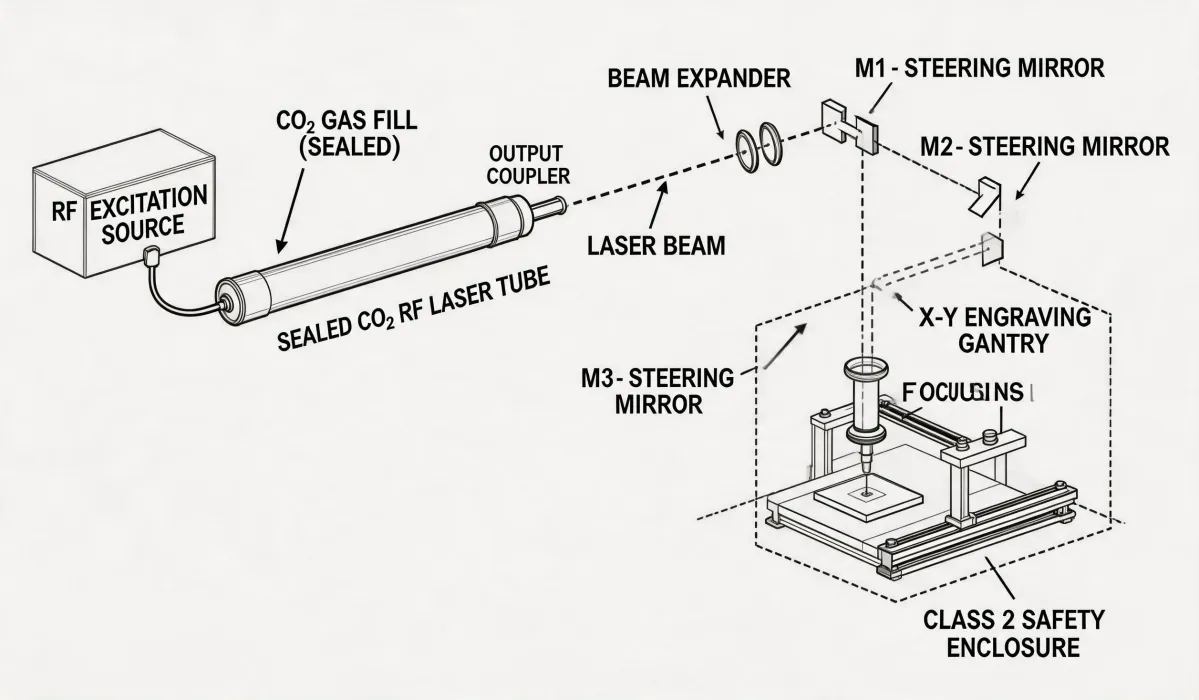
CO2 RF sealed tube beam path diagram
Typical power stability envelope: ±2% over an 8-hour duty cycle, measured at the output coupler at full-power steady state. Values are representative of Fusion Pro Class and documented on the serialized test sheet that ships with each machine.
ParameterHelix 24Fusion Pro 32Fusion Pro 48
Wavelength10.6 µm10.6 µm (CO2) + 1064 nm (fiber)10.6 µm (CO2) + 1064 nm (fiber)
Source Power Options30 / 50 / 75 W30–120 W CO2 / 20–50 W fiber50–120 W CO2 / 20–50 W fiber
Bed Size24” × 18” (610 × 458 mm)32” × 20” (813 × 508 mm)48” × 36” (1219 × 914 mm)
Z-axis Travel9” (229 mm)10.75” (273 mm)12.25” (311 mm)
Raster Resolution (native)1200 DPI1200 DPI1200 DPI
Vector SpeedUp to 85 IPSUp to 150 IPSUp to 150 IPS
InterfaceEthernet / USBEthernet, IRIS cameraEthernet, IRIS camera, Pass-through
2. Fiber Laser Source

IPG single-mode, 1064 nm, MOPA pulse tuning.

The FiberMark S2 and Fusion Pro fiber channel use IPG Photonics single-mode fiber sources at 1064 nm with MOPA (Master Oscillator Power Amplifier) architecture. MOPA allows independent control of pulse duration (4–200 ns), pulse repetition rate (1–1000 kHz), and average power, producing color marks on stainless and clean annealing on titanium without the thermal bloom of Q-switched-only sources.

Beam quality: M² < 1.2 for single-mode 20–50 W fiber sources, characterized per IPG factory data and verified on arrival in Golden. Average power stability is ±2% typical over 8-hour duty at rated wattage.

Pulse-duration decision matrix

Pulse DurationTypical Use CaseMaterial Example
4–20 nsDeep engrave / material removalStainless steel, carbon steel depth marking
20–60 nsAnnealing / color markingStainless 304/316L color mark, titanium annealing
60–200 nsCoating removalCerakote, laser-markable anodize, black oxide
3. Galvo Head Dynamics

Digital galvanometer scanning for high-speed marking.

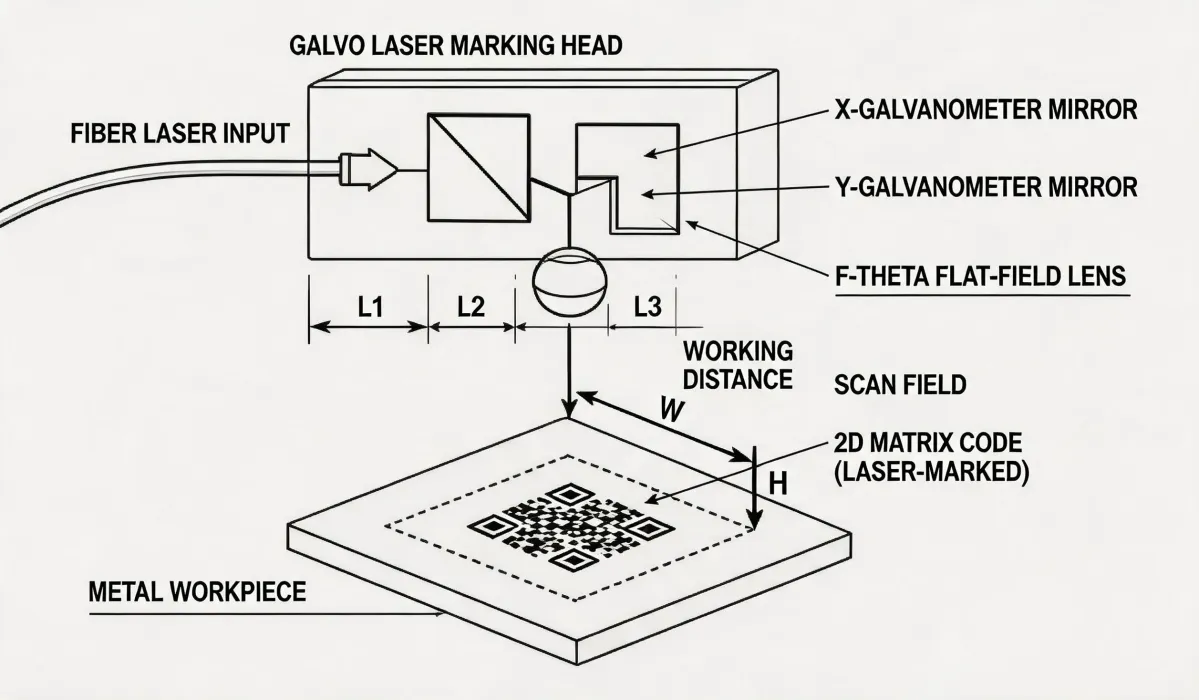
FiberMark S2 uses a digital galvanometer scanner pair with 12–16 bit position feedback. Steady-state marking speed reaches 7,000 mm/s single-stroke vector, with field corrections applied via an XY distortion table calibrated to the focusing lens's f-theta characteristic. Positioning accuracy is characterized against a calibrated reticle during final QA.

Galvo head scan field with f-theta lens
SpecificationFiberMark S2 20WFiberMark S2 30WFiberMark S2 50W
Fiber Wavelength1064 nm MOPA1064 nm MOPA1064 nm MOPA
Beam Quality (M²)< 1.2< 1.2< 1.3
Marking Speed (max)7,000 mm/s7,000 mm/s7,000 mm/s
Scan Field (f-theta)110 × 110 mm std (4” × 4”)110 × 110 mm std110 × 110 mm std, 160 mm option
Positioning Accuracy±0.02 mm typical±0.02 mm typical±0.025 mm typical
4. Motion Control & Enclosure

Closed-loop stepper stages inside a CDRH Class 2 cabinet.

Epilog CO2 platforms use closed-loop stepper motion on a lightweight carbon-composite X-gantry, tuned for stiffness-to-mass ratio during raster reversals. The enclosure is CDRH Class 2 rated: viewing window filters 10.6 µm CO2 radiation and 1064 nm fiber wavelengths, and opening the door is interlocked to beam shutter closure within the latency window specified in IEC 60825-1.

A sticky-top control panel exposes all pulse-by-pulse parameters to the operator — power, speed, frequency, focus offset — without requiring a laptop connection. This matters for production floors that run the same job sheet across multiple shifts.

5. Epilog Suite & RIP Stack

Native raster image processor, no cloud dependency.

Epilog Suite is the driver + job manager that translates vector art from CorelDRAW, Illustrator, and AutoCAD into motion commands. It runs on Windows endpoints on the local network — no cloud login, no subscription — because customers running factory-qualified machines under ISO 9001 traceability cannot accept cloud-dependency risk on their laser workflow.

The RIP handles raster queueing, vector prioritization, color-to-power mapping, and per-job frequency override. Materials Library recipes are stored as XML per substrate and can be versioned in a local repository, enabling audit trails for 21 CFR Part 11 contexts.

The PostScript "nostringval" runtime error occasionally seen with older CorelDRAW fonts is a driver-side known-issue with a documented workaround: convert text to curves/outlines before sending the job. Full diagnostic notes are on the engineering blog.

Get the full engineering spec sheet.

Every configuration ships with a serialized test sheet and a downloadable engineering brief (beam profile, thermal design, calibration procedure). Request yours before you request quote.